




ZMDE Steel Machinery continues the WeldSafe Essentials series with practical, shop-floor welding safety and process optimization content. This issue (#18) focuses on one of the most critical yet frequently mismanaged parameters in CO₂ Gas Shielded Welding (commonly called CO₂ MIG welding or MAG welding with high CO₂ content): Shielding Gas Flow Rate and Nozzle-to-Work Distance (also referred to as Nozzle-to-Plate Distance or a close variant of CTWD).
These two parameters are not fixed — they must be adjusted according to welding current to achieve stable arc, effective gas coverage, minimal porosity/spatter, and good bead appearance.
In WeldSafe Essentials #18 we explain exactly why these values change with current and provide the most reliable field-proven ranges (based on industrial practice, equipment manuals, and real-world validation). Always test-weld on scrap material before production.
Forward vs. Backward Travel: The Basics
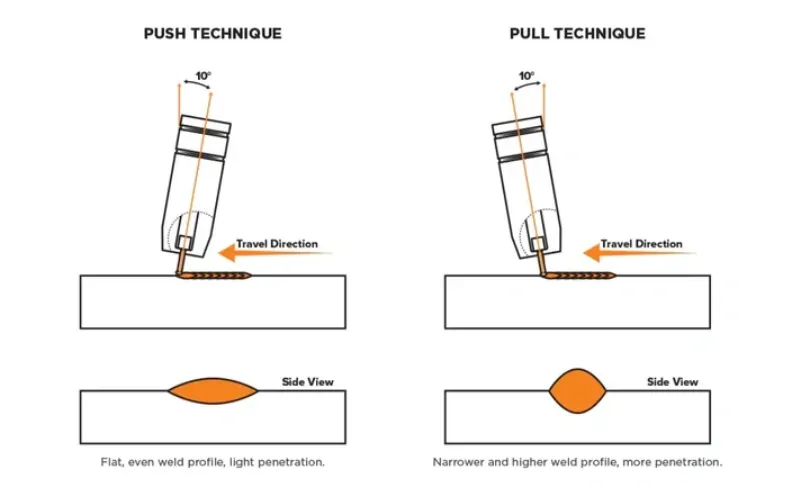
- Forward Method (Push / Forehand)
- Torch points forward in the direction of travel.
- Travel angle: Typically 5°–20° forward (torch tilted ahead of perpendicular).
- The arc pushes the molten pool ahead, flattening it out for a wider, smoother bead.
- Backward Method (Pull / Drag / Backhand)
- Torch points backward against the direction of travel.
- Travel angle: Typically 5°–20° backward (torch tilted behind perpendicular).
- The arc drags the pool, building a higher, narrower crown with deeper penetration.
Effects on Weld Quality
- Push technique generally produces cleaner welds with less spatter and better gas shielding because the gas flows forward over the still-molten pool—ideal for CO₂ welding to reduce porosity risks.
- Pull technique gives deeper penetration but can trap more spatter and cause slight porosity if gas coverage is marginal (common in high-current CO₂ setups).
- Perpendicular (0°) is acceptable for some flat-position work but often results in average penetration and more spatter than angled techniques.
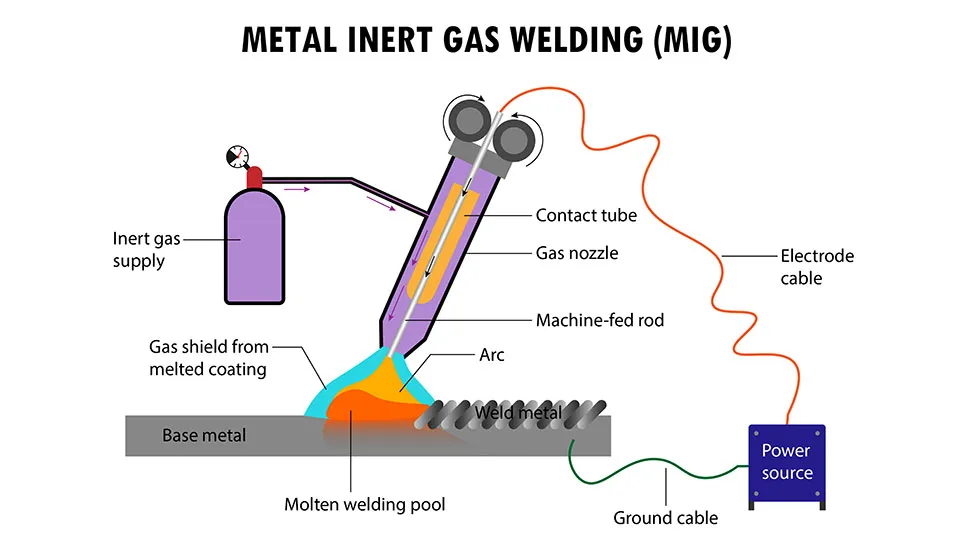
Practical Guidelines
- Start with 10°–15° angle — Most welders find this the sweet spot for balance between penetration, bead shape, and spatter control in CO₂ MIG applications.
- Adjust based on material and position —
- Aluminum → Push almost always (better cleaning action and less porosity).
- Steel fillet welds → Pull for deeper root penetration.
- Vertical up → Slight push or perpendicular to control puddle.
- CO₂-specific: Combine with proper gas flow (e.g., 20-25 L/min for 200-350A) and nozzle distance (15-20 mm) to optimize shielding.
- Maintain consistent angle — Wobbling the torch causes uneven beads and defects.
- Combine with travel speed — Too fast with push = shallow penetration; too slow with pull = excessive buildup.
Quick Pre-Weld Reminder
- Decide push or pull based on desired penetration and finish.
- Set travel angle 5°–20° in chosen direction.
- Keep torch steady and angle consistent throughout the bead.
- Test on scrap first — observe arc stability, spatter, and bead profile.
Conclusion: Angle and Direction Control the Outcome
The same machine settings can produce a flat, clean bead or a deep, crowned one simply by changing torch angle and travel direction. Master the 0°–20° range and choose push or pull intentionally—your welds will gain consistency, appearance, and strength, especially in demanding CO₂ applications.
Which do you prefer—push or pull—and why? Share your go-to technique in the comments.
Tags: CO2 welding, MIG, torch angle, push pull, travel direction, welding safety, penetration, spatter control, bead profile, WeldSafe Essentials
Related posts
- Welding Safety: The Role of the MIG Torch Gas Diffuser (Gas Screen) – Essential for Quality and Protection (WeldSafe Essentials 16)
- Welding Safety: Avoid Overly Long or Coiled Welding Cables – Maintain Power and Arc Stability (WeldSafe Essentials 15)
ZMDE Steel Machinery integrates R&D, manufacturing, sales, and service, with expertise in intelligent H/T beam structural production lines, Industry IoT, and control systems.
Shanghai Headquarters: 999 Yunjuan Road, China (Shanghai) Pilot Free Trade Zone Lin-gang Special Area, Shanghai China Shandong Base: 3888 Yinda Road, Weifang City, Shandong China Email: export.zmde@zmdetech.com
Tel: +86 131 6226 6595 (WeChat)
+86 180 0536 5092 (Marketing WhatsApp)
+86 185 2178 3568 (Sales WhatsApp)